






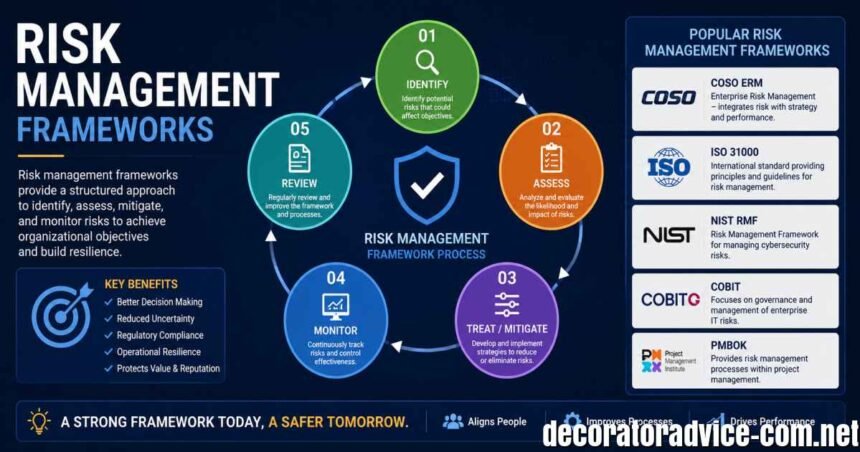
A Risk Management Framework (RMF) is no longer something reserved for large enterprises or government agencies—it has become a business necessity in 2026. As organizations face increasing cybersecurity threats, AI-related risks, regulatory changes, supply chain disruptions, and evolving ESG (Environmental, Social, and Governance) expectations, a structured risk management approach is essential for long-term success.
Whether you’re searching for what is a risk management framework, best risk management frameworks, or how to implement an RMF, this comprehensive 2026 guide explains everything you need to know. You’ll learn how modern frameworks help businesses identify, assess, mitigate, and continuously monitor risks while improving compliance, resilience, and decision-making.
What Is a Risk Management Framework?
A Risk Management Framework (RMF) is a structured and systematic approach that enables organizations to identify, assess, prioritize, mitigate, monitor, and communicate risks across the business. Rather than reacting to threats after they occur, an RMF provides standardized principles, policies, and procedures that help organizations proactively manage uncertainty.
Every effective framework is designed to answer four essential questions:



- What could go wrong?
- How likely is it to happen, and what would the impact be?
- What actions should we take to reduce or manage the risk?
- How do we know our controls are working effectively?
Unlike ad hoc or informal risk management, a formal RMF improves consistency, accountability, governance, regulatory compliance, and continuous improvement. In 2026, businesses must also address newer categories of risk that were often overlooked just a few years ago, including digital transformation risks, AI governance, third-party/vendor risks, cloud security, and ESG-related risks.
The primary objective of any Enterprise Risk Management (ERM) framework is to reduce risks to an acceptable level while enabling organizations to pursue growth opportunities with confidence.
Top 7 Risk Management Frameworks You Should Know in 2026
Choosing the right framework depends on your organization’s size, industry, regulatory requirements, and business goals. Below are the seven most widely adopted risk management frameworks in 2026.
1. NIST Risk Management Framework (NIST RMF)
Developed by the National Institute of Standards and Technology (NIST), this framework is considered the benchmark for cybersecurity risk management and U.S. federal compliance. It consists of seven core steps:
- Prepare
- Categorize
- Select
- Implement
- Assess
- Authorize
- Monitor
Organizations handling sensitive information or working with U.S. government agencies commonly rely on NIST SP 800-37 for robust cybersecurity governance.
2. ISO 31000:2018
ISO 31000 is the leading international standard for Enterprise Risk Management (ERM). Rather than prescribing strict rules, it provides flexible principles suitable for organizations of any size.
Its key principles include:
- Integration
- Structured approach
- Customization
- Inclusivity
- Continuous improvement
This framework is especially valuable for multinational organizations building a strong enterprise-wide risk culture.
3. COSO Enterprise Risk Management (ERM)
The COSO ERM Framework, developed by the Committee of Sponsoring Organizations, connects risk management with business strategy and organizational performance.
The updated framework emphasizes:
- Governance
- Organizational culture
- Strategic planning
- Performance measurement
- Risk appetite alignment
It remains one of the preferred frameworks for financial reporting, internal audit, and corporate governance.
4. FAIR Framework
The Factor Analysis of Information Risk (FAIR) framework differs from traditional models by expressing cybersecurity risk in financial terms.
Instead of labeling risks as “High” or “Medium,” FAIR estimates potential financial losses, helping executives answer questions like:
“How much could this cyber risk cost our organization each year?”
This quantitative approach has become increasingly popular among Fortune 500 CISOs and executive leadership teams.
5. NIST Cybersecurity Framework (CSF) 2.0
Updated in 2024, NIST CSF 2.0 has become one of the world’s most adopted cybersecurity frameworks.
Its six core functions include:
- Govern
- Identify
- Protect
- Detect
- Respond
- Recover
Organizations building modern cybersecurity programs frequently begin with this framework.
6. COBIT
Developed by ISACA, COBIT (Control Objectives for Information and Related Technologies) focuses on IT governance, ensuring technology investments support business objectives while managing IT-related risks effectively.
7. PMI Risk Management Framework
The Project Management Institute (PMI) framework specializes in project risk management, helping organizations identify, evaluate, and respond to risks that threaten project budgets, schedules, and deliverables.
The 6 Core Steps of Every Risk Management Framework
Although terminology varies between frameworks, nearly every successful RMF follows six universal stages.
1. Risk Identification
The first step involves identifying every significant internal and external risk affecting the organization, including:
- Operational risk
- Financial risk
- Strategic risk
- Compliance risk
- Cybersecurity risk
- Reputational risk
- Third-party/vendor risk
Organizations often use SWOT analysis, risk workshops, historical incident reviews, and increasingly AI-powered risk detection tools.
2. Risk Assessment and Analysis
Each identified risk should be evaluated according to its likelihood and potential business impact.
Many organizations use:
- Risk matrices
- Heat maps
- Scenario analysis
- Quantitative methods like FAIR
Modern organizations increasingly rely on data-driven analysis rather than subjective “high, medium, low” ratings.
3. Risk Prioritization
Because resources are limited, organizations prioritize risks based on risk appetite and risk tolerance established by leadership.
Critical risks with both high probability and severe impact receive immediate attention.
4. Risk Mitigation and Treatment
Organizations typically choose one of four treatment strategies:
- Avoid
- Mitigate
- Transfer
- Accept
Examples include implementing multi-factor authentication (MFA), purchasing cyber insurance, diversifying suppliers, improving internal policies, or deploying additional security controls.
5. Risk Monitoring and Reporting
Risk management is an ongoing process rather than a one-time project.
Leading organizations continuously monitor:
- Key Risk Indicators (KRIs)
- Automated dashboards
- Compliance reports
- Security alerts
- GRC platforms
Continuous monitoring allows businesses to detect emerging threats before they become major incidents.
6. Risk Communication and Governance
Effective frameworks ensure risks are communicated clearly from operational teams to executive leadership and the board of directors.
Strong governance creates accountability and builds a culture where every employee understands their role in managing organizational risk.
How to Implement a Risk Management Framework in 2026
Implementing an RMF doesn’t have to be overwhelming. Most successful organizations follow five practical phases.
Define governance and risk appetite. Executive leadership should establish the organization’s acceptable level of risk, appoint risk owners, and, where appropriate, create a Chief Risk Officer (CRO) or risk committee.
Select the appropriate framework. Avoid creating a custom framework from scratch when proven standards already exist. Technology companies pursuing SOC 2 often combine NIST CSF 2.0 with ISO 27001, while financial institutions frequently integrate COSO and FAIR. Many enterprises adopt ISO 31000 for enterprise risk management while using NIST specifically for cybersecurity.
Conduct a baseline risk assessment. Evaluate current controls, identify compliance gaps, and understand your organization’s overall risk posture.
Implement controls and supporting technology. Modern Governance, Risk, and Compliance (GRC) platforms such as ServiceNow GRC, OneTrust, and RSA Archer help automate documentation, testing, reporting, and compliance activities.
Train employees and continuously improve. Regular awareness training, tabletop exercises, cyber incident simulations, and quarterly framework reviews ensure your RMF evolves alongside emerging threats and changing regulations.
Common Risk Management Mistakes to Avoid
Even organizations with formal frameworks can struggle if they make avoidable mistakes.
One of the biggest errors is treating risk management as solely an IT responsibility. Enterprise risk affects every department, including finance, operations, legal, HR, and executive leadership.
Another common mistake is relying only on qualitative risk ratings. Executives and boards often need financial impact estimates rather than color-coded heat maps.
Organizations also fail when risk ownership is unclear. Every significant risk should have a designated owner responsible for monitoring and mitigation.
Ignoring third-party vendor risk has become increasingly dangerous in 2026, as supply chain attacks continue to rise. Vendor assessments and continuous monitoring should be integrated into every RMF.
Finally, avoid adopting a “set it and forget it” mindset. A framework stored in a PDF document provides little value unless it is actively maintained, monitored, tested, and improved.
Which Risk Management Framework Is Best in 2026?
There is no single best risk management framework for every organization. The ideal choice depends on your industry, regulatory obligations, business objectives, and risk maturity.
For most organizations, a hybrid approach delivers the strongest results:
- ISO 31000 for enterprise-wide risk management.
- NIST Cybersecurity Framework (CSF) 2.0 for cybersecurity governance and compliance.
- FAIR for financial risk quantification and board-level decision-making.
- COSO ERM for aligning risk with business strategy and corporate governance.
Organizations that implement a Risk Management Frameworks, and continuously monitored Risk Management Framework in 2026 will be better positioned to withstand cyber threats, regulatory changes, operational disruptions, and emerging technologies. Beyond passing audits, a strong RMF helps build customer trust, improve business resilience, attract investors, and create a competitive advantage in an increasingly uncertain business environment.